|
Investigation Course

|
SUCCESSFUL INVESTIGATIONS
Correct investigations depend on
correct Whys. You can understand a real Why
if you realize this:
A REAL WHY OPENS THE DOOR TO
HANDLING.
If you write down a Why, ask this
question of it: “Does this open the door to handling?”
If it does not, then it is a wrong
Why.
When you have a right Why, handling
becomes simple. The more one has to beat his brains for a bright idea to
handle, the more likely it is that he has a wrong Why.
So if the handling doesn’t leap out
at you then THE WHY HAS NOT OPENED THE DOOR and is probably wrong.
A right Why opens the door to
improvement, enabling one to work out a handling which, if correctly done, will
attain the envisioned ideal scene. Investigatory Technology can be applied to
situations good or bad, large or small, dispelling many of life’s puzzles and
making real solutions possible.
DOING AN INVESTIGATION
When one begins to apply data
analysis, he is often still trying to grasp the data about data analysis rather
than the outpoints in the data. The remedy is just become more familiar with
the materials of this course.
Further, one may not realize the
ease with which one can acquire the knowledge of an ideal scene. An outpoint is
simply an illogical departure from the ideal scene. By comparing the existing
scene with the ideal scene, one easily sees the outpoints.
To know the ideal scene, one has
only to work out the correct products for it. If these aren’t getting out, then
there is a departure. One can then find the outpoints of the various types and
then locate a Why and in that way open the door to handling. And by handling,
one is simply trying to get the scene to get out its products.
Unless one proceeds in this fashion
(from product back to establishment), one can’t analyze much of anything. One
merely comes up with errors.
An existing scene is as good as it
gets out its products, not as good as it is painted or carpeted or given public
relations boosts.
So for any scene, manufacturing or fighting a war or being
a hostess at a party, there are products.
People who lead pointless lives are
very unhappy people. Even the idler or dilettante is happy only when he has a
product!
There is always a product for any
scene.
Standard Action
A beginner can juggle around and go
badly adrift if he doesn’t follow the pattern:
1. Work out exactly what the (person, unit,
activity) should be producing.
2. Work out the ideal scene.
3. Investigate the existing scene.
4. Follow outpoints back from ideal
to existing.
5. Locate the real Why that will move the
existing toward ideal.
6. Look over existing resources.
7. Get a bright idea of how to handle.
8. Handle or recommend handling so that it
stays handled.
This is a very surefire
approach.
If one just notes errors in a scene,
with no product or ideal with which to compare the existing scene, he will not
be doing data analysis and situations will deteriorate badly because he is
finding wrong Whys.
Thinking
One has to be able to think with
outpoints. A crude way of saying this is “learn to think like an idiot.” One
could also add “without abandoning any ability to think like a genius.”
If one can’t tolerate outpoints at
all or confront them, one can’t see
them.
A madman can’t tolerate pluspoints
and he doesn’t see them either.
But there can be a lot of pluspoints
around and no production. Thus, one can be told how great it all is while the
place edges over to the point of collapse.
One who listens to people on the
scene and takes their Whys
runs a grave risk. If these were the
Whys, then things would be better.
A far safer way is to talk only
insofar as finding what the product is concerned and investigating.
One should observe the existing
scene through data or through observers or through direct observation.
One often has to guess what the Why
might be. It is doing that which brings up the phrase “Learn to think like an
idiot.” The Why will be found at the end of a trail of outpoints. Each one is
an aberration when compared to the ideal scene. The biggest idiocy which then explains
all the rest and which opens the door to improvement toward the ideal scene is
the Why.
One also has to learn to think like
a genius with pluspoints.
Get the big peak period of
production (now or in the past). Compare it to the existing scene just
before.
Now find the pluspoints that were
entered in. Trace these and you arrive at the Why as the biggest pluspoint that
opened the door to improvement.
But once more one considers
resources available and has to get a bright idea.
So it is the same series of steps as
above but with pluspoints.
WHYS
One uses the above knowledge and
skill to track down the real reason for the positive or nonoptimum situation.
This is called a “Why.”
Why = that basic outness found which will lead to
a recovery of statistics.
Wrong Why = the incorrectly identified outness which
when applied does not lead to recovery.
A
mere explanation = a “Why”
given as the Why that
does not open the door to any recovery.
Example: A mere explanation: “The
statistics went down because of rainy weather that week.” So? So do we now turn
off rain? Another mere explanation: “The staff became overwhelmed that week.”
An order saying “Don’t overwhelm staff” would be the possible “solution” of
some manager. BUT THE STATISTICS WOULDN’T RECOVER.
The real Why when found and corrected leads straight
back to improved stats (statistics).
A wrong Why, corrected, will further
depress stats.
A mere explanation does nothing at
all and decay continues.
Here is a situation as it is
followed up:
The stats of an area were down.
Investigation disclosed there had been sickness two weeks before. The report
came in: “The statistics were down because people were sick.” This was a mere
explanation. Very reasonable. But it solved nothing. What do we do now? Maybe
we accept this as the correct Why. And give an order, “All people in the area
must get a medical exam and unhealthy workers will not be accepted and
unhealthy ones will be fired.” As it’s a correction to a wrong Why, the stats really crash. So that’s not it.
Looking further we find the real Why. In the area, a boss gives orders to the
wrong people which, when executed, then hurt their individual stats. We
organize the place, train the boss and we get a stat recovery and even
an improvement.
The correct Why led to a stat recovery.
Here is another one. Statistics are down in a school. An investigation comes up
with a mere explanation: “The students were all busy with sports.” So
management says “No sports!” Statistics go down again. A new investigation
comes up with a wrong Why: “The students are being taught wrongly.” Management
sacks the dean. Statistics really crash now. A further, more competent
investigation occurs. It turns out that there were 140 students and only the
dean and one instructor! And the dean had other duties! We return the dean to
his job and hire two more instructors making three. Statistics soar. Because we
got the right Why.
Management and organizational
catastrophes and successes are all
explained by these three types of Why. An arbitrary, a false order or datum
entered into a situation, is probably just a wrong Why held in by law. And if
so held in, it will crash the place.
One really has to understand logic
to get to the correct Why and must really be on his toes not to use and correct
a wrong Why.
In world banking, where inflation
occurs, finance regulations or laws are probably just one long parade of wrong
Whys. The value of the money and its usefulness to the citizen deteriorate to
such an extent that a whole ideology can be built up (as in Sparta by Lycurgus
[a Greek lawgiver] who invented iron money nobody could lift in order to rid
Sparta of money evils) that knocks money out entirely and puts nothing but
nonsense in its place.
Organizational troubles are greatly
worsened by using mere explanations (which lead to no remedies) or wrong Whys
(which further depress stats). Organizational recoveries come from finding the
real Why and correcting it.
The test of the real Why is “When it
is corrected, do stats recover?” If they do that was it. And any other remedial
order given but based on a wrong Why would have to be cancelled quickly.
INVESTIGATORY ACTIONS
Correction of things which are not
wrong and neglecting things which are not right puts the tombstone on any
organization or civilization.
This boils down to correct investigation. It is not
a slight skill. It is the
basic skill behind any intelligent action.
Suppressive Justice
When justice goes astray (as it
usually does) the things that have occurred are:
1. Use of justice for some
other purpose than public safety (such as maintaining a privileged group or
indulging a fixed idea) or
2. Omitted use of investigatory
procedure.
All suppressive use of the forces of
justice can be traced back to one or the other of these.
Aberrations and hate very often find
outlet by calling them “justice” or “law and order.” This is why it can be said
that man cannot be trusted with justice.
This or just plain stupidity bring
about a neglect of intelligent investigatory procedures. Yet all group sanity
depends upon correct and unaberrated (rational) investigatory procedures. Only
in that way can one establish causes of things. And only by establishing causes
can one cease to be the effect of unwanted situations.
It is one thing to be able to
observe. It is quite another to utilize observations so that one can get to the
basis of things.
Sequences
Investigations become necessary in
the face of outpoints or pluspoints.
Investigations can occur out of idle
curiosity or particular interest. They can also occur to locate the cause of
pluspoints.
Whatever the motive for
investigation, the action itself is conducted by sequences.
If one is incapable mentally of
tracing a series of events or actions, one cannot investigate.
Altered sequence is a primary block
to investigation.
At first glance, omitted data would
seem to be the block. On the contrary, it is the end product of an
investigation and is what pulls an investigation along—one is looking for
omitted data.
An altered sequence of actions
defeats any investigation.
Examples: We will hang him and then conduct a trial.
We will assume who did it and then find evidence to prove it. A crime should be
provoked to find who commits them.
Any time an investigation gets
back-to-front, it will not succeed.
Thus, if an investigator himself has
any trouble with seeing or visualizing sequences of actions, he will inevitably
come up with the wrong answer.
Reversely, when one sees that someone
has come up with a wrong or incomplete answer, one can assume that the
investigator has trouble with sequences of events or, of course, did not really
investigate.
One can’t really credit that
Sherlock Holmes would say, “I have here the fingerprint of Mr. Murgatroyd on
the murder weapon. Have the police arrest him. Now, Watson, hand me a
magnifying glass and ask Sgt. Doherty to let us look over his fingerprint
files.”
If one cannot visualize a series of
actions, like a ball bouncing down a flight of stairs, or if one cannot relate
in proper order several different actions with one object into a proper
sequence, he will not be able to investigate.
If one can, that’s fine.
Investigations
All betterment of life depends on
finding out pluspoints and why and reinforcing them, locating outpoints and why
and eradicating them.
This is the successful survival
pattern of living. A primitive who is going to survive does just that and a
scientist who is worth anything does just that.
The fisherman sees sea gulls
clustering over a point on the sea. That’s the beginning of a short sequence,
point number one. He predicts a school of fish, point number two. He sails over
as sequence point number three. He looks down as sequence point number four. He
sees fish as point number five. He gets out a net as point number six. He
circles the school with the net, number seven. He draws in the net, number
eight. He brings the fish on board, number nine. He goes to port, number ten.
He sells the fish, number eleven. That’s following a pluspoint—cluster of sea
gulls.
A sequence from an outpoint might
be: Housewife serves dinner. Nobody eats the cake, number one; she tastes it,
number two; she recognizes soap in it, number three. She goes to kitchen,
number four. She looks into cupboard, number five. She finds the soapbox upset,
number six. She sees the flour below it, number seven. She sees cookie jar
empty, number eight. She grabs young son, number nine. She shows him the setup,
number ten. She gets a confession, number eleven. And number twelve is too
painful to describe.
Discoveries
All discoveries are the end product
of a sequence of investigatory actions that begin with either a pluspoint or an
outpoint.
Thus all knowledge proceeds from
pluspoints or outpoints observed.
And all knowledge depends on an
ability to investigate.
And all investigation is done in
correct sequence.
And all successes depend upon the
ability to do these things.
FAMILIARITY
If one has no familiarity with how a
scene (area) ought to be, one cannot easily spot outpoints (illogical data)
in it.
This is what also could be called an
ideal scene or
situation. If one doesn’t know the ideal
scene or situation then one is not likely to observe nonideal
points in it.
Let us send a farmer to sea. In a
mild blow, with the sails and their gear creaking and water hitting the hull,
he is sure the ship is about to sink. He has no familiarity with how it should
sound or look so he misses any real outpoints and may consider all pluspoints
as outpoints.
Yet on a calm and pretty day he sees
a freighter come within five hundred feet of the side and go full astern and
thinks everything is great.
An experienced officer may attempt
madly to avoid collision and all the farmer would think was that the officer
was being impolite! The farmer, lacking any familiarity with the sea and having
no ideal as to what
smooth running would be, would rarely see real outpoints unless he drowned. Yet
an experienced sailor, familiar with the scene in all its changing faces sees
an outpoint in all small illogicals.
On the other hand, the sailor on the
farm would completely miss disease in the wheat and an open gate and see no
outpoints in a farm that the farmer knew was about to go bust.
The rule is:
A PERSON MUST HAVE AN IDEAL SCENE
WITH WHICH TO COMPARE THE EXISTING SCENE.
If a staff hasn’t got an idea of how
a real organization should run, then it misses obvious outpoints.
One sees examples of this when an
experienced organization executive visiting an organization tries to point out
to a green staff (which has no ideal or familiarity) what is out. The green
staff grudgingly fixes up what he says to do but lets go of it the moment he
departs. Lacking familiarity and an ideal of a perfect organization, the green
staff just doesn’t see anything wrong or anything right either!
The consequences of this are
themselves illogical. One sees an untrained executive firing all the producers
and letting the bad hats (corrupt or worthless people) alone. His erroneous
ideal would be a quiet organization, let us say. So he dismisses anyone who is
noisy or demanding. He ignores statistics. He ignores the things he should
watch merely because he has a faulty ideal and no familiarity of a
proper scene.
Observation Errors
When the scene is not familiar one
has to look hard to become aware of things. You’ve noticed tourists doing this.
Yet the old resident “sees” far more than they do while walking straight ahead
down the road.
It is easy to confuse the novel with
the “important fact.” “It was a warm day for winter” is a useful fact only when
it turns out that actually everything froze up on that day or it indicated some
other outpoint.
Most errors in observation are made
because one has no ideal for the scene or no familiarity with it.
However there are other
error sources.
“Being reasonable” is the chief
offender. People dub in (presume or have a false, delusory perception of) a
missing piece of a sequence, for instance, instead of seeing that it is missing. A false datum is
imagined to exist because a sequence is wrong or has a missing step.
It is horrifying to behold how
easily people buy dub-in. This is because an illogical sequence is
uncomfortable. To relieve the discomfort they distort their own observation by
ignoring the outpoint and concluding something else.
Accurate Observation
There are certain conditions
necessary for accurate observation.
First is a means of perception whether by remote
communication byvarious communication lines or by direct looking,
feeling, experiencing.
Second is an ideal of how the scene or area
should be.
Third is familiarity with how such scenes are when things are
going wellor poorly.
Fourth is understanding pluspoints or rightnesses
when present.
People easily buy
imaginary data. To relieve the discomfort they distort their own observation by
ignoring the outpoint and concluding something else.
Fifth is knowing outpoints (all types) when
they appear.
Sixth is rapid ability to analyze data.
Seventh is the ability to analyze the situation.
Eighth is the willingness to inspect more closely the area of
outness.
Then one has to have the knowledge
and imagination necessary to handle.
One could call the above the cycle of observation. If one
calls handle number
nine it would be the Cycle of Control. If one is trained to conceive all
variations of outpoints (illogics) and studies up to conceive an ideal and
gains familiarity with the scene or type of area, his ability to observe and
handle things would be considered almost supernatural.
DATA AND SITUATION
ANALYZING
That one gains an excellent
understanding of logic and a good grasp of the types of outpoints and
pluspoints is vital to investigation. With this as a foundation, the two
general steps one has to take to “find out what is really going on” are:
1. Analyze
the data,
2. Using
the data thus analyzed to analyze the situation.
The term data is defined as facts, graphs, statements,
decisions, actions, descriptions, which are supposedly true. Situation is defined as the broad
general scene on which a body of current data exists.
The way to analyze data is to compare it to the
outpoints and see if any of those appear in the data.
The way to analyze the situation is to put in its
smaller areas each of the data analyzed as above.
Doing this gives you the locations
of greatest error or disorganization and also gives you areas of greatest
effectiveness.
Example: There is trouble in the
Refreshment Unit. There are three people in the unit. Doing a data analysis on
the whole area gives us a number of outpoints. Then we assign these to
employees A, B and C who work in the unit and find B had the most outpoints.
This indicates that the trouble in the Refreshment Unit is with B. B can be
handled in various ways such as training him on the duties of his job, his
attendance, etc. Note we analyzed the data
of the main area and assigned it to the bits in the area, then we had an
analyzed situation and we could handle.
Example: We analyze all the data we
have about the Bingo Car Plant. We assign the data thus analyzed as out
(outpoints) to each function of the Bingo Car Plant. We thus pinpoint what
function is the worst off. We then handle that function in various ways,
principally by organizing it and training its executives and personnel.
There are several variations.
WE OBTAIN AN ANALYSIS OF THE
SITUATION BY ANALYZING ALL THE DATA WE HAVE AND ASSIGNING THE OUTPOINT DATA TO
THE AREAS OR PARTS. THE AREA HAVING THE MOST OUTPOINTS IS THE TARGET FOR
CORRECTION.
In confronting a broad situation to
be handled, we have of course the problem of finding out what’s wrong before we
can correct it. This is done by data analysis followed by situation
analysis.
We do this by grading all the data
for outpoints (illogics). We now have a long list of outpoints. This is data
analysis.
We sort the outpoints we now have
into the principal areas of the scene. The majority will appear in one area. This is situation
analysis.
We now know what area to
handle.
Example: Seventy data exist on the
general scene. We find twenty-one of these data are irrational (outpoints). We
slot the twenty-one outpoints into the areas they came from or apply to.
Sixteen came from area G. We handle area G.
Experience
The remarkable part of such an
exercise is that the data analysis of the data of a period of one day compares
to three months operating experience.
Thus data and situation analysis is
an instant result where experience takes a lot of time.
One obtains an
analysis of a situation by analyzing all the data one has and assigning the
outpoint data to the areas or posts. The area having the most outpoints is the
target for correction.
The quality of the data analysis
depends on one knowing the ideal organization and purpose on which the activity
is based. This means one has to know what its activities are supposed to be from a rational or
logical viewpoint.
A clock is supposed to keep running
and indicate time and be of practical and pleasant design. A clock factory is
supposed to make clocks. It is supposed to produce enough clocks cheaply enough
that are good enough to be in demand and to sell for enough to keep the place
solvent. It consumes raw materials, repairs and replaces its tools and
equipment. It hires workmen and executives. It has service firms and distributors.
That is the sort of thing one means by ideal
or theoretical structure of the clock company and its
organization.
Those are the rational points.
From the body of actual current
today data on the clock company one spots the outpoints for a data analysis.
One assigns the outpoints to the
whole as a situation analysis.
One uses his admin know-how and
expertise to repair the most aberrated subsection.
One gets a functioning clock factory
that runs closer to the ideal.
Military, political and PR situations,
etc., are handled all in the same way.
We call these two actions:
DATA ANALYSIS
SITUATION ANALYSIS
PLUSPOINTS
There are one or more conditions
which exist when a situation or circumstance is logical. These are called
pluspoints. A pluspoint is
a datum of truth found to be true when compared to the following list of
logical conditions.
Pluspoints show where logic exists and where things are
going right or likely to.
Where things get better or there is
a sudden improvement in an area or organization, the cause for this should be
found to reinforce what was successful. Such an investigation is done by use of
pluspoints.
The pluspoints are as follows:
RELATED FACTS KNOWN. (All relevant
facts known.)
EVENTS IN CORRECT SEQUENCE. (Events
in actual sequence.)
TIME NOTED. (Time is properly noted.)
DATA PROVEN FACTUAL. (Data must be factual, which is to say, true and valid.)
CORRECT RELATIVE IMPORTANCE. (The important and unimportant are correctly sorted out.)
EXPECTED TIME PERIOD. (Events
occurring or done in the time one would reasonably expect them to be.)
ADEQUATE DATA. (No sectors of
omitted data that would influence the situation.)
APPLICABLE DATA. (The data presented
or available applies to the matter in hand and not something else.)
CORRECT SOURCE. (Not wrong source.)
CORRECT TARGET. (Not going in some direction that would be wrong for the situation.)
DATA IN SAME CLASSIFICATION. (Data
from two or more different classes of material not introduced as the
same class.)
IDENTITIES ARE IDENTICAL.
(Not similar or different.)
SIMILARITIES ARE SIMILAR.
(Not identical or different.)
DIFFERENCES ARE DIFFERENT.
(Not made to be identical or similar.)
In finding out why things got better
so they can be repeated, it is vital to use the actual pluspoints by name
as above.
Pluspoints are, after all, what make
things go right.
Not Know
One can always know something
about anything.
It is a wise man who, confronted
with conflicting data, realizes that he knows at least one thing—that he
doesn’t know.
Grasping that, he can then take
action to find out.
If he evaluates the data he does
find out against the things above, he can clarify the situation. Then he can
reach a logical conclusion.
Drills
It is necessary to work out your own
examples of the violations of logic described herein.
By doing so, you will have gained
skill in sorting out the data of a situation.
When you can sort out data and
become skilled in it, you will become very difficult to fool and you will have
taken the first vital step in grasping a correct estimate of
any situation.
LOGIC
The subject of logic has been under
discussion for at least three thousand years without any clean breakthrough of
real use to those who work with data.
“Logic” means the subject of
reasoning. Some in ages past have sought to label it a science. But that can be
discarded as pretense and pompousness.
If there were such a “science,” men
would be able to think. And they can’t.
The term itself is utterly forbidding.
If you were to read a text on logic, you would go quite mad trying to figure it
out, much less learn how to think.
Yet logic or the ability to reason
is vital to an organizer or administrator. If he cannot think clearly, he will
not be able to reach the conclusions vital to make correct decisions.
Many agencies, governments,
societies, groups capitalize upon this lack of logic and have for a very long
time. A population that is unable to think or reason can be manipulated easily
by falsehoods and wretched causes.
Thus logic has not been a supported
subject, rather the opposite.
Even Western schools have sought to
convince students they should study geometry as “that is the way they think.”
And of course it isn’t.
The administrator, the manager, the
artisan and the clerk each have a considerable use for logic. If they cannot
reason, they make costly and time-consuming errors and can send the entire
organization into chaos and oblivion.
Their stuff in trade are data and
situations. Unless they can observe and think their way through, they can reach
wrong conclusions and take incorrect actions.
Modern man thinks mathematics can
serve him for logic and most of his situations go utterly adrift because of
this touching and misplaced confidence. The complexity of human problems and
the vast number of factors involved make mathematics utterly inadequate.
Computers are at best only crutches
to the mind. Yet the chromium-plated civilization today has a childish faith in
them. It depends on who asks the questions and who reads the computer’s answers
whether they are of any use or not. And even then their answers are often
madhouse silly.
Computers can’t think because the rules of live
logic aren’t fully known to man and computer builders. One false datum fed into
a computer gives one a completely wrong answer.
If people on management and work
lines do not know logic, an organization can go adrift and require a fabulous
amount of genius to hold it together and keep it running.
Whole civilizations vanish because
of lack of logic in its rulers, leaders and people.
So this is a very important
subject.
Unlocking Logic
Scientology contains a way to unlock
logic. This is a breakthrough which is no small win. If by it a formidable and
almost impossible subject can be reduced to simplicity, then correct answers to
situations can be far more frequent and an organization or a civilization far
more effective.
The breakthrough is a simple
one:
BY ESTABLISHING THE WAYS IN WHICH
THINGS BECOME ILLOGICAL, ONE CAN THEN ESTABLISH WHAT IS LOGIC.
In other words, if one has a grasp
of what makes things illogical or irrational (or crazy, if you please) it is
then possible to conceive of what makes things logical.
Illogics
There are specific ways for a relay
of information or a situation to become illogical. These are the things which
cause one to have an incorrect idea of a situation. Each different way is
called an outpoint,
which is any one datum that is offered as true that is in fact found to be
illogical. Each one of these is described below.
Omitted Data
An omitted anything is an
outpoint.
This can be an omitted person,
terminal (person who sends, receives and relays communication), object, energy,
space, time, form, sequence or even an omitted scene. Anything that can be omitted that should be there is an
outpoint.
This is easily the most overlooked
outpoint as it isn’t there to directly attract attention.
Altered Sequence
Any things, events, objects, sizes,
in a wrong sequence is an outpoint.
The number series 3, 7, 1, 2, 4, 6,
5 is an altered sequence, or an incorrect sequence.
Doing step two of a sequence of
actions before doing step one can be counted on to tangle any sequence of
actions.
The basic outness is no sequence at
all. (An outness is a condition
or state of something being incorrect, wrong or missing.) This leads into FIXED
IDEAS. It also shows up in what is called disassociation, an insanity. Things
connected to or similar to each other are not seen as consecutive. Such people
also jump about subjectwise without relation to an obvious sequence.
Disassociation is the extreme case where things that are related are not seen
to be and things that have no relation are conceived to have.
“Sequence” means linear (in a line)
travel either through space or time or both.
A sequence that should be one and
isn’t is an outpoint.
A “sequence” that isn’t but is
thought to be one is an outpoint.
A cart-before-the-horse out of
sequence is an outpoint.
One’s hardest task sometimes is
indicating an inevitable sequence into the future that is invisible to another.
This is a consequence. “If you saw off the limb you are sitting on you will of
course fall.” Police try to bring this home often to people who have no concept
of sequence; so the threat of punishment works well on well-behaved citizens
and not at all on criminals since they often are criminals because they can’t
think in sequence—they are simply fixated. “If you kill a man you will be
hanged,” is an indicated sequence. A murderer fixated on revenge cannot think
in sequence. One has to think in sequences to have correct sequences.
Therefore, it is far more common
than one would at first imagine to see altered sequences since persons who do
not think in sequence do not see altered sequences in their own actions or
areas.
Visualizing sequences and drills in
shifting attention can clean this up and restore it as a faculty.
Motion pictures and TV were spotted
by a writer as fixating attention and not permitting it to travel. Where one
had TV-raised children, it would follow, one possibly would have people with a
tendency to altered sequences or no sequences at all.
Dropped Time
Time that should be noted and isn’t
would be an outpoint of “dropped time.” It is a special case of an omitted
datum. Dropped time has a peculiarly ferocious effect that adds up to utter
lunacy.
A news bulletin from 1814 and one
from 1922 read consecutively without time assigned produces otherwise
undetectable madness.
A summary report of a situation
containing events strung over half a year without saying so can provoke a
reaction not in keeping with the current scene.
In madmen the present is the dropped
time, leaving them in the haunted past. Just telling a group of madmen to “come
up to present time” will produce a few miraculous “cures.” And getting the date
of an ache or pain will often cause it to vanish.
Time aberrations (illogicalities)
are so strong that dropped time well qualifies as an outpoint.
Falsehood
When you hear two facts that are
contrary, one is a falsehood or both are.
Propaganda and other activities
specialize in falsehoods and provoke great disturbance.
Willful or unintentional, a
falsehood is an outpoint. It may be a mistake or a calculated or defensive
falsehood and it is still an outpoint.
A false anything qualifies for this
outpoint. A false being, terminal, act, intention, anything that seeks to be
what it isn’t is a falsehood and an outpoint.
Fiction that does not pretend to be
anything else is of course not a falsehood.
So the falsehood means “other than
it appears” or “other than represented.”
One does not have to concern oneself
to define philosophic truth or reality to see that something stated or modeled
to be one thing is in actual fact something else and therefore an
outpoint.
Altered Importance
An importance shifted from its
actual relative importance, up or down, is an outpoint.
Something can be assigned an
importance greater than it has.
Something can be assigned an
importance less than it has.
A number of things of different
importances can be assigned a monotone of importance.
These are all outpoints, three
versions of the same thing.
All importances are relative to
their actuality.
Wrong Target
A mistaken objective wherein one
believes he is or should be reaching toward A and finds he is or should be
reaching toward B is an outpoint.
This is commonly mistaken identity.
It is also mistaken purposes or goals.
“If we tear down X we will be okay”
often results in disclosure that it should have been Y.
Killing the king to be free from
taxation leaves the tax collector alive for the next regime.
Injustice is usually a wrong target
outpoint.
Arrest the drug consumer, award the
drug company would be an example.
Military tactics and strategy are
almost always an effort to coax the selection of a wrong target by the
enemy.
And most dislikes and spontaneous
hates in human relations are based on mistaken associations of Bill for
Pete.
A large sum of aberration is based
on wrong targets, wrong sources, wrong causes.
Incorrectly tell a patient he has
ulcers when he hasn’t and he’s hung with an outpoint which impedes
recovery.
The industry spent on wrong
objectives would light the world for a millennium.
Wrong Source
“Wrong source” is the other side of
the coin of wrong target.
Information taken from wrong source,
orders taken from the wrong source, gifts or materiel (supplies) taken from
wrong source all add up to eventual confusion and possible trouble.
Unwittingly receiving from a wrong
source can be very embarrassing or confusing, so much so that it is a favorite
intelligence trick. Department D in East Germany, the Department of
Disinformation, had very intricate methods of planting false information and
disguising its source.
Technology can come from wrong
source. For instance, Leipzig University’s school of psychology and psychiatry
opened the door to death camps in Hitler’s Germany. Using drugs, these men
apparently gave Hitler to the world as their puppet. At the end of World War II
these extremists formed the “World Federation of Mental Health,” which enlisted
the American Psychiatric Association and the American Medical Association and
established “National Associations for Mental Health” over the world. These
became the sole advisors to the US government on “mental health, education and
welfare” and the appointers of all health ministers through the civilized
world. This source is so wrong that it is destroying man, having already
destroyed scores of millions.
Not only taking data from wrong
source but officialdom from it can therefore be sufficiently aberrated as to
result in planetary insanity.
In a lesser level, taking a report
from a known bad hat (corrupt or worthless person) and acting upon it is the usual reason for errors made in
management.
Contrary Facts
When two statements are made on one
subject which are contrary to each other, we have “contrary facts.”
This illogic could be classified as
a falsehood, since one of them must be false.
But in investigatory procedure one
cannot offhand distinguish which is the false fact. Thus it becomes a special
outpoint.
“The company made an above average
income that week” and “They couldn’t pay the employees” occurring in the same
time period gives us one or both as false. We may not know which is true but we
do know they are contrary and can so label it.
In interrogation this point is so
important that anyone giving two contrary facts becomes a prime suspect for further
investigation. “I am a Swiss citizen” as a statement from someone who has had a
German passport found in his baggage would be an example.
When two “facts” are contrary or
contradictory, we may not know which is true but we do know they can’t both be
true.
Issued by the same organization,
even from two different people in that organization, two contradictory “facts”
qualifies as an outpoint.
Added Time
In this outpoint we have the reverse
of dropped time. In added time we have, as the most common example, something
taking longer than it possibly could. To this degree it is a version of
conflicting data—for example, something takes three weeks to do but it is
reported as taking six months. But added time must be called to attention as an
outpoint in its own right for there is a tendency to be “reasonable” about it
and not see that it is
an outpoint in itself.
In its most severe sense, added time
becomes a very serious outpoint when, for example, two or more events occur at
the same moment involving, let us say, the same person who could not have
experienced both. Time had to be added
to the physical universe for the data to be true. Like this: “I left for Saigon
at midnight on April 21, 1962, by ship from San Francisco.” “I took over my
duties at Saigon on April 30, 1962.” Here we have to add time to the physical
universe for both events to occur as a ship would take two or three weeks to
get from San Francisco to “Saigon.”
Another instance, a true occurrence
and better example of added time, happened when a checklist of actions it would
take a month to complete was sent to a junior executive and compliance was
received in full in the next return mail. The checklist was in her hands only
one day! She would have had to add twenty-nine days to the physical universe
for the compliance report to be true. This was also dropped time on her
part.
Added Inapplicable Data
Just plain added data does not
necessarily constitute an outpoint. It may be someone being thorough. But when
the data is in no way applicable to the scene or situation and is added, it is
a definite outpoint.
Often added data is put there to
cover up neglect of duty or mask a real situation. It certainly means the
person is obscuring something.
Usually added data also contains
other types of outpoints like wrong target or added time.
In using this outpoint be very sure
you also understand the word inapplicable
and see that it is only an outpoint if the data itself does not apply to the
subject at hand.
Incorrectly Included Datum
There is an outpoint called incorrectly included datum, which
is a companion to the omitted datum as an outpoint.
This most commonly occurs when, in
the mind, the scene itself is missing and the first thing needed to classify
data (scene) is not there.
An example is camera storage by
someone who has no idea of types
of cameras. Instead of classifying all the needful bits of a certain camera in
one box, one inevitably gets the lens hoods of all cameras jumbled into one box marked “lens
hoods.” To assemble or use the camera one spends hours trying to find its parts
in boxes neatly labeled “camera backs,” “lenses,” “tripods,” etc.
Here, when the scene of what a
set-up camera looks like and operates like, is missing, one gets a closer
identification of data than exists. lens hoods are lens hoods. Tripods are
tripods. Thus a wrong system of classification occurs out of scene
ignorance.
A traveler unable to distinguish one
uniform from another “solves” it by classifying all uniforms as “porters.”
Hands his bag to an arrogant police captain and that’s how he spent his
vacation, in jail.
Lack of the scene brings about too
tight an identification of one thing with another.
A newly called-up army lieutenant
passes right on by an enemy spy dressed as one of his own soldiers. An
experienced sergeant right behind him claps the spy in jail accurately because
“he wasn’t wearing ’is ’at the way we do in our regiment!”
Times change data classification. In
1920 anyone with a camera near a seaport was a spy. In 1960 anyone not carrying
a camera couldn’t be a tourist so was watched!
So the scene for one cultural period
is not the scene for another.
There are three other types of
outpoints which should be known for use in an investigation.
Assumed “Identities”
Are Not Identical
Assumed
“Similarities” Are Not Similar Or Same Class Of Thing
Assumed
“Differences” Are Not Different
Handling Data
There are hundreds of ways these
mishandlings of data can then give one a completely false picture.
When basing actions or orders on
data which contains one of the above, one then makes a mistake.
REASON DEPENDS ON DATA.
WHEN DATA IS FAULTY (as above) THE
ANSWER WILL BE WRONG AND LOOKED UPON AS UNREASONABLE.
There are a vast number of
combinations of these data. More than one (or all) may be present in the
same report.
Observation and its communication
may contain one of these illogics.
If so, then any effort to handle the
situation will be ineffective in correcting or handling it.
Use
If any body of data is given the
above tests, it is often exposed as an invitation to acting illogically.
To achieve a logical answer one must
have logical data.
Anybody of data which contains one
or more of the above faults can lead one into illogical conclusions.
The basis of an unreasonable or
unworkable order is a conclusion which is made illogical by possessing one or
more of the above faults.
INVESTIGATION AND ITS USE
From day to day and week to week,
one can face many less-than-desirable circumstances in his life. Somehow one
manages to slog through these situations, convinced there is not much he can do
to improve his lot. Perhaps a project planned for months at work doesn’t come
off with the expected success; productivity in the office has declined sharply
during the past quarter; or the addition to one’s house takes longer than first
envisioned. Such situations are common enough occurrences for many of us.
But these need not be the usual
state of affairs. People can live a happy existence and accomplish their goals
in any area of life—individually, with the family, the job and so on. The aims
an individual once visualized for himself can be accomplished.
If such goals are not being attained
or if one is in a situation that has deteriorated or worsened, there is a
valid, locatable cause for this. This concept is one people often do not
realize—things are actually caused. They don’t just happen. There are
reasons behind every situation—reasons that people themselves can
control.
Without knowing this, man often
relies upon “fate,” superstition, fortunetelling or astrology to determine his
destiny or future. Many just hope vainly that nothing else will go wrong or
they deceive themselves with the belief that life is ordinarily a
struggle.
For example, a farmer with a very
poor crop one year has no credible explanation for it. He has no concept that
he himself caused this condition. However, looking into it, one would find that
he had earlier failed to keep seed grain secure for the spring planting, and
thus it fell prey to insects. Not knowing this, he might come up with all sorts
of odd “reasons” or just blame it on bad luck.
In a factory with low production,
management could be shifting personnel, hiring new workers, etc., in an attempt
to raise productivity before the organization goes under. But executives might
not have the skills needed to really examine the company’s own operations to find
the cause of the situation. Upon inspection, one could discover that the
suppliers of its raw materials refused to deliver because the company’s
accounting office wasn’t paying the bills.
To look into, handle and improve any
such situation in any area of life requires skill in investigation—the
ability to think logically and get to the bottom of things.
Investigation is the careful
discovery and sorting of facts. In investigating, one is searching out and
examining the particulars of something in an attempt to learn the facts,
especially in an attempt to find a cause.
A proper investigation gets to the
bottom of the state of affairs facing one. For instance, in any organization,
one could observe that its production was down. This is a nonoptimum situation
which should be investigated and the cause located. Investigations can also be
utilized in an individual’s personal life to improve conditions.
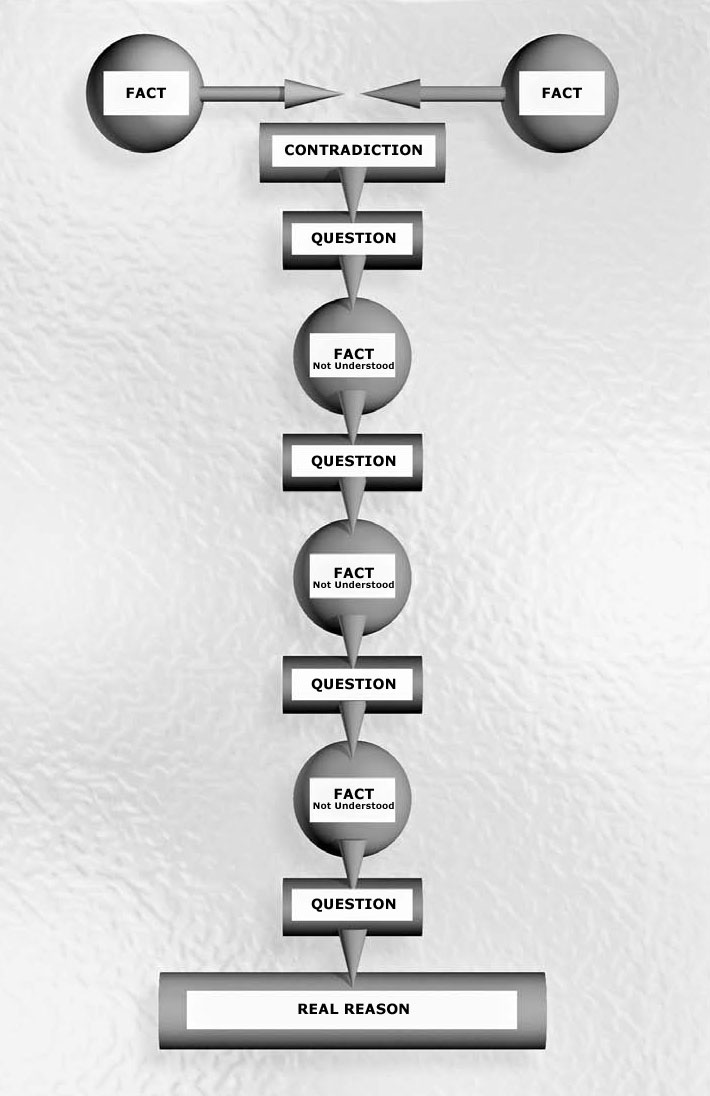
In doing an investigation, you are
asking the question, “What don’t I understand?” with regard to the existing
conditions. You’ll find that two facts don’t agree—they contradict themselves
and can’t be understood. So you try to rationalize these two facts: you
question these two facts and you will get another point you don’t understand.
And when you try to get this point understood, you will now find another
fact that you don’t understand. And someplace along the way, you will find the
reason for the circumstances you are investigating.
Any investigation should proceed
along these lines. Sometimes many questions have to be asked, sometimes it only
takes a “What’s that noise?” to lead one to the source of a difficulty. Here is
an example of an investigation done on a rapid, emergency basis: An engineer is
on duty in a ship’s engine room. He has normal but experienced perception: is
observing his area. Hears a hiss that shouldn't be—something contradictory to
the expected conditions in an engine room. Scans the area and sees nothing out
of order but a small white cloud. Combines sight and hearing. Moves forward to
get a better look. Sees valve has broken. Shuts off steam line.
In a nutshell, (a) one finds an
imperfect functioning of some portion of an organization or whatever he is
investigating and then (b) finds something that one doesn’t understand about it
and then (c) questions the individuals in that portion connected with the
imperfect functioning or looks into the area to get more data.
Following this sequence isolates the
cause of the trouble which can then be handled so the area properly operates
again. In an organization, one can apply just these three steps over and over
again, and it will usually be quite enough to keep it running quite
smoothly.
Statistics play a role in
investigations. A statistic shows the production of an activity, area or
organization, as compared to an earlier moment in time. It reflects whether or
not the area is achieving its purpose—if statistics are up, it is more closely
accomplishing what is intended for the area. In doing an investigation, one
looks for down statistics. These aren’t understandable, of course, so
one questions the people concerned. In their answers there will be something
that doesn’t make sense at all to the person doing the investigation—for
example, “We can’t pay the bills because Josie has been doing a course.” The
investigator is only looking for something he himself can’t reconcile. So he
questions the person who gave this data and Josie. Sooner or later the
real reason shows up.
As one is going down the trail of
things he can’t understand, one of two things will happen. Either it is a dead
end and it doesn’t go any further, at which time he returns to the main line of
the investigation, or it produces further material. And if it produces further
material, one will find more things he can’t understand.
 The trick of this procedure is to
find a piece of string sticking out—something one can’t understand and, by
questioning, pull on it. A small cat shows up. Pull on the string by asking
more questions. A baby gorilla shows up. Pull some more. A tiger appears. Pull
again and wow! You’ve got a General Sherman tank! The trick of this procedure is to
find a piece of string sticking out—something one can’t understand and, by
questioning, pull on it. A small cat shows up. Pull on the string by asking
more questions. A baby gorilla shows up. Pull some more. A tiger appears. Pull
again and wow! You’ve got a General Sherman tank!
In encountering two facts that contradict, one questions on
these two facts and gets another point he doesn’t understand. He continues on
this path of things he doesn’t get until the real reason is
located.
It isn’t reasonable for
people to be lazy or stupid. At the bottom you find the real cause of no
action in a portion of an organization or continuous upset.
When you have your “General Sherman
tank,” you can take action.
There’s always a reason behind
a bad statistic. Question those involved until you have the real reason
in view. It will never be “Agnes isn’t bright.” It is more likely, Agnes was
hired as a typist but never knew how to type. Or the executive over the area
simply never comes to work.
The real explanation of a down
statistic is always a very easily understood thing. If you question enough,
you’ll get the real explanation and then you can act.
This technique of investigation,
while elementary, is highly effective. It can be applied when faced with simple
or complex situations to get to the bottom of them, and therefore enables one
to resolve them and improve conditions in life.
Investigatory skills improve with
practice. They can be sharpened and made more effective so that one is able to
instantly spot something he doesn’t understand. This ability is not innate in
people but can be easily acquired. To make investigations even more rapid and
effective, one should be able to understand and apply the principles of logic—a
subject that until now has not only been misunderstood but has been made
unnecessarily complex.
|