
INVESTIGATION AND ITS USE
From day to day and week to week,
one can face many less-than-desirable circumstances in his life. Somehow one
manages to slog through these situations, convinced there is not much he can do
to improve his lot. Perhaps a project planned for months at work doesn’t come
off with the expected success; productivity in the office has declined sharply
during the past quarter; or the addition to one’s house takes longer than first
envisioned. Such situations are common enough occurrences for many of us.
But these need not be the usual
state of affairs. People can live a happy existence and accomplish their goals
in any area of life—individually, with the family, the job and so on. The aims
an individual once visualized for himself can be accomplished.
If such goals are not being attained
or if one is in a situation that has deteriorated or worsened, there is a
valid, locatable cause for this. This concept is one people often do not
realize—things are actually caused. They don’t just happen. There are
reasons behind every situation—reasons that people themselves can
control.
Without knowing this, man often
relies upon “fate,” superstition, fortunetelling or astrology to determine his
destiny or future. Many just hope vainly that nothing else will go wrong or
they deceive themselves with the belief that life is ordinarily a
struggle.
For example, a farmer with a very
poor crop one year has no credible explanation for it. He has no concept that
he himself caused this condition. However, looking into it, one would find that
he had earlier failed to keep seed grain secure for the spring planting, and
thus it fell prey to insects. Not knowing this, he might come up with all sorts
of odd “reasons” or just blame it on bad luck.
In a factory with low production,
management could be shifting personnel, hiring new workers, etc., in an attempt
to raise productivity before the organization goes under. But executives might
not have the skills needed to really examine the company’s own operations to find
the cause of the situation. Upon inspection, one could discover that the
suppliers of its raw materials refused to deliver because the company’s
accounting office wasn’t paying the bills.
To look into, handle and improve any
such situation in any area of life requires skill in investigation—the
ability to think logically and get to the bottom of things.
Investigation is the careful
discovery and sorting of facts. In investigating, one is searching out and
examining the particulars of something in an attempt to learn the facts,
especially in an attempt to find a cause.
A proper investigation gets to the
bottom of the state of affairs facing one. For instance, in any organization,
one could observe that its production was down. This is a nonoptimum situation
which should be investigated and the cause located. Investigations can also be
utilized in an individual’s personal life to improve conditions.
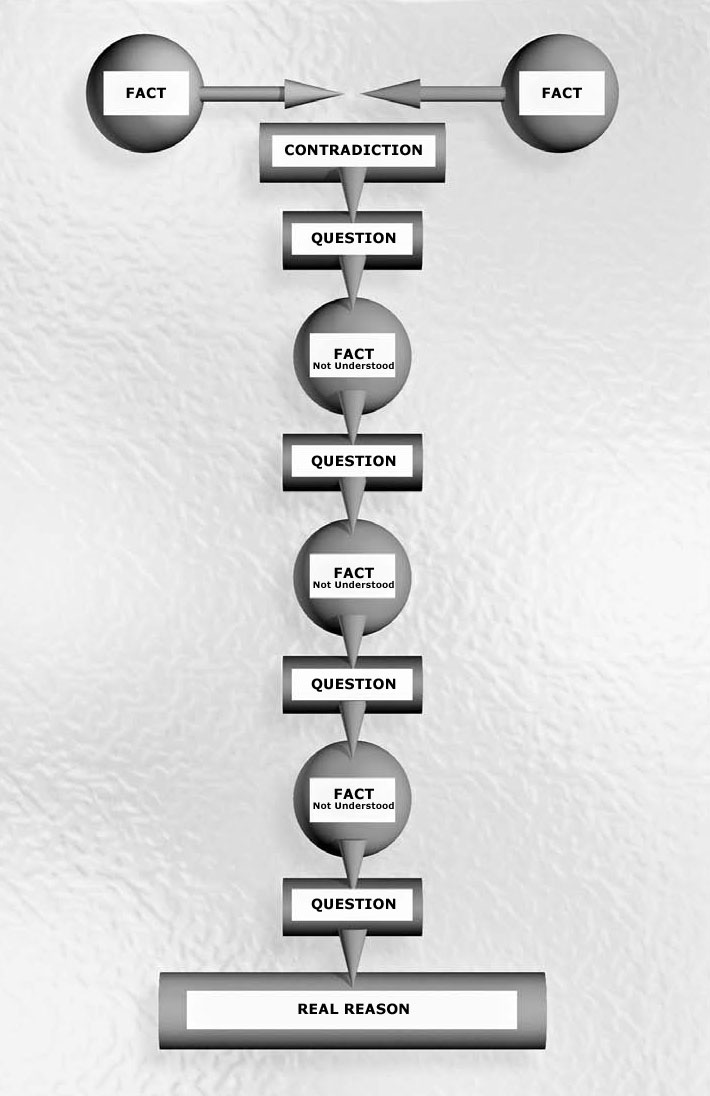
In doing an investigation, you are
asking the question, “What don’t I understand?” with regard to the existing
conditions. You’ll find that two facts don’t agree—they contradict themselves
and can’t be understood. So you try to rationalize these two facts: you
question these two facts and you will get another point you don’t understand.
And when you try to get this point understood, you will now find another
fact that you don’t understand. And someplace along the way, you will find the
reason for the circumstances you are investigating.
Any investigation should proceed
along these lines. Sometimes many questions have to be asked, sometimes it only
takes a “What’s that noise?” to lead one to the source of a difficulty. Here is
an example of an investigation done on a rapid, emergency basis: An engineer is
on duty in a ship’s engine room. He has normal but experienced perception: is
observing his area. Hears a hiss that shouldn't be—something contradictory to
the expected conditions in an engine room. Scans the area and sees nothing out
of order but a small white cloud. Combines sight and hearing. Moves forward to
get a better look. Sees valve has broken. Shuts off steam line.
In a nutshell, (a) one finds an
imperfect functioning of some portion of an organization or whatever he is
investigating and then (b) finds something that one doesn’t understand about it
and then (c) questions the individuals in that portion connected with the
imperfect functioning or looks into the area to get more data.
Following this sequence isolates the
cause of the trouble which can then be handled so the area properly operates
again. In an organization, one can apply just these three steps over and over
again, and it will usually be quite enough to keep it running quite
smoothly.
Statistics play a role in
investigations. A statistic shows the production of an activity, area or
organization, as compared to an earlier moment in time. It reflects whether or
not the area is achieving its purpose—if statistics are up, it is more closely
accomplishing what is intended for the area. In doing an investigation, one
looks for down statistics. These aren’t understandable, of course, so
one questions the people concerned. In their answers there will be something
that doesn’t make sense at all to the person doing the investigation—for
example, “We can’t pay the bills because Josie has been doing a course.” The
investigator is only looking for something he himself can’t reconcile. So he
questions the person who gave this data and Josie. Sooner or later the
real reason shows up.
As one is going down the trail of
things he can’t understand, one of two things will happen. Either it is a dead
end and it doesn’t go any further, at which time he returns to the main line of
the investigation, or it produces further material. And if it produces further
material, one will find more things he can’t understand.
 The trick of this procedure is to
find a piece of string sticking out—something one can’t understand and, by
questioning, pull on it. A small cat shows up. Pull on the string by asking
more questions. A baby gorilla shows up. Pull some more. A tiger appears. Pull
again and wow! You’ve got a General Sherman tank!
The trick of this procedure is to
find a piece of string sticking out—something one can’t understand and, by
questioning, pull on it. A small cat shows up. Pull on the string by asking
more questions. A baby gorilla shows up. Pull some more. A tiger appears. Pull
again and wow! You’ve got a General Sherman tank!
In encountering two facts that contradict, one questions on
these two facts and gets another point he doesn’t understand. He continues on
this path of things he doesn’t get until the real reason is
located.
It isn’t reasonable for
people to be lazy or stupid. At the bottom you find the real cause of no
action in a portion of an organization or continuous upset.
When you have your “General Sherman
tank,” you can take action.
There’s always a reason behind
a bad statistic. Question those involved until you have the real reason
in view. It will never be “Agnes isn’t bright.” It is more likely, Agnes was
hired as a typist but never knew how to type. Or the executive over the area
simply never comes to work.
The real explanation of a down
statistic is always a very easily understood thing. If you question enough,
you’ll get the real explanation and then you can act.
This technique of investigation,
while elementary, is highly effective. It can be applied when faced with simple
or complex situations to get to the bottom of them, and therefore enables one
to resolve them and improve conditions in life.
Investigatory skills improve with
practice. They can be sharpened and made more effective so that one is able to
instantly spot something he doesn’t understand. This ability is not innate in
people but can be easily acquired. To make investigations even more rapid and
effective, one should be able to understand and apply the principles of logic—a
subject that until now has not only been misunderstood but has been made
unnecessarily complex.


0 comments:
Post a Comment